
Land Value Capture as a tool for Urban Development: Effects on the community.
Land value capture (LVC) is one of the most debated tools in contemporary urban policy. Land Value Capture (LVC) is how governments recover the extra value added to land by public investments (like roads, transit, or parks) either by taxing it as revenue or reinvesting it directly in community upgrades that benefit all residentsi. Land value capture is applied using several different approaches, such as development charges, land readjustment, tax-increment financing, betterment levies, and special assessments. The underlying logic is simple and ethically compelling: when a new metro line or park raises nearby, land values increase by millions. The community/ government that paid for that infrastructure should benefit, not just private landowners ii. In theory, LVC operates as a virtuous cycle: public investment increases land values, the resulting uplift is captured as revenue, and that revenue is then reinvested into further public improvements.
Cities across the globe have used LVC successfully. In São Paulo, the Certificados de Potencial Adicional de Construção (CEPAC) system raised billions for mobility and social housingiii. Hong Kong’s rail-plus-property model has financed one of the world’s most profitable metro systems without government subsidiesiv. In the United States, tax increment financing (TIF) districts have funded downtown revitalisation in Chicago, Portland, and Atlanta v. In Addis Ababa and Hyderabad, land leasing and sale of development rights have become major revenue sources for expanding citiesvi. Yet, the advantages come with significant drawbacks, especially for the poorest urban residents. LVC is hard to implement because it’s difficult to measure how much of the land value increase is truly “unearned.” It also creates political tensions because many landowners strongly oppose being taxed on this extra valuevii. Negotiated contributions often end up lower than theoretical potential due to bargaining power imbalances between municipalities and large developersviii. Moreover, in volatile real estate markets, over-reliance on LVC can create fiscal instabilityix.
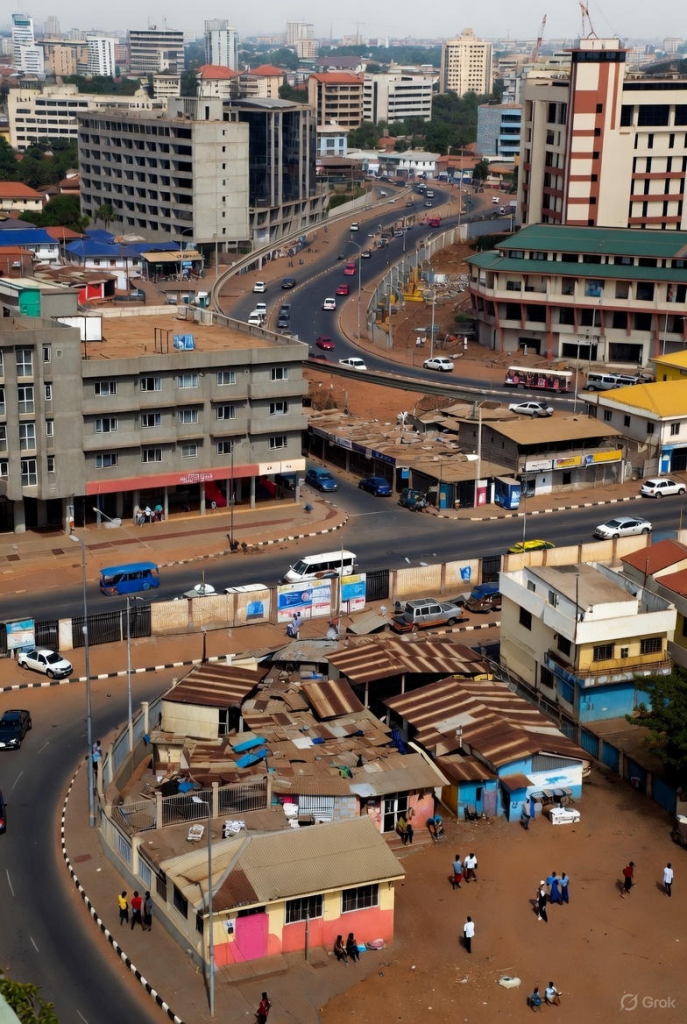
The most severe and least-discussed disadvantage, however, is its role in displacing squatters and informal settlers, thereby deepening spatial inequality. When public investment or rezoning triggers land value uplift in low-income or informally occupied areas, the economic logic of LVC incentivises formal redevelopment. Squatter settlements, which often occupy centrally located, high-potential land, suddenly become the most attractive targets for value capture projectsx. As land prices soar, informal residents who lack legal title are unable to pay rising rents, property taxes are pushed outxi.
Empirical studies confirm this pattern. In Mumbai, the construction of the Eastern Freeway and subsequent land-value increases led to mass evictions of informal settlements with minimal compensation . In Nairobi, the planned light-rail corridor through Kibera one of Africa’s largest informal settlements has already triggered speculative land grabs and evictions ahead of formal LVC mechanisms xii.
This displacement is not merely an unfortunate side effect; it is structurally embedded in the mechanics of LVC. The higher the captured value, the stronger the incentive to clear informal occupants and replace them with higher-value usesxiiixiv. The result is a familiar geography of exclusion: low-income households are relocated to the urban periphery, far from jobs, services, and social networks, while prime central land is redeveloped for middle- and upper-income residentsxv. Over time, this creates or reinforces socio-spatial fragmentation and residential segregationxvi. Scholars advocating spatial justice therefore argue that LVC must be paired with strong anti-displacement measures: community land trusts, inclusionary zoning with no-net-loss requirements, long-term tenure security for informal settlers, and participatory planning that gives affected communities veto power or direct shares in captured valuexvii. In conclusion, land value capture remains a powerful and necessary tool for funding equitable urban development, but only when explicitly designed to protect the most vulnerable. Without deliberate safeguards, the same mechanism that promises to make cities fairer can become one of the most effective engines of spatial inequality and forced displacement in the modern metropolis.
Ghana can reduce spatial inequality by using captured land value to subsidise long-term (60-99 year) leases at nominal rent for displaced families in the same redeveloped central neighbourhoods.
This keeps low-income residents in high-value areas without requiring them to buy or pay market rates.
It creates truly mixed communities and stops the usual push to the urban fringe.
